The Cybersecurity Maturity Model Certification (CMMC) framework is more than just a government requirement—it’s a roadmap for strengthening an organization\'s entire cybersecurity posture. For manufacturers and other businesses seeking or maintaining Department of Defense contracts, understanding and meeting the full scope of CMMC can be overwhelming without expert support.
That’s where IT compliance firms come in. They not only interpret the complex requirements of the CMMC framework but also provide a structured plan for achieving and maintaining compliance.
Understanding the Full Scope of CMMC
CMMC is designed to protect Controlled Unclassified Information (CUI) and Federal Contract Information (FCI) across the Defense Industrial Base. Unlike earlier self-assessment models, CMMC includes a third-party assessment requirement and builds cybersecurity maturity into its structure.
The framework spans multiple domains such as Access Control, Incident Response, Risk Management, and System and Communications Protection. Each domain includes specific practices and processes that must be implemented at varying maturity levels.
An IT compliance firm helps clients understand how these domains apply to their business, clarifying where existing policies fall short and what must be added or improved.
Translating Compliance Language into Actionable Steps
The language in the CMMC framework isn’t always business-friendly. Many companies struggle with interpreting requirements like "Implement subnetworks for publicly accessible system components" or "Establish and maintain a cyber incident response plan."
Compliance firms break this down into clear, manageable actions tailored to the client’s systems, operations, and internal resources. They identify relevant controls, help determine the appropriate CMMC level, and create documentation and policies aligned with NIST 800-171, which CMMC is largely based on.
Building an Implementation Roadmap
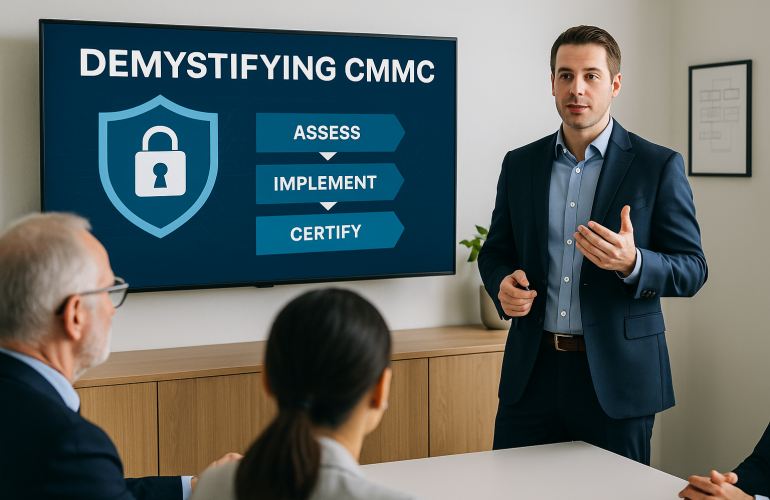
Most businesses aren’t ready to become CMMC certified overnight. IT compliance firms design a step-by-step roadmap that typically includes:
-
Readiness assessment: A gap analysis to determine where the client stands relative to the desired CMMC level.
-
Remediation planning: Clear timelines and milestones for addressing technical and policy-related deficiencies.
-
Technology alignment: Recommendations for tools such as endpoint detection and response (EDR), security information and event management (SIEM), multi-factor authentication (MFA), and secure backup solutions.
-
Process integration: Implementation of compliance processes such as regular log reviews, access audits, and incident response drills.
Each phase is documented and supported to ensure progress is measurable and aligned with assessor expectations.
Policy and Documentation Support
CMMC demands strong documentation—both of technical controls and the procedures used to maintain them. IT compliance firms support clients by drafting or reviewing:
-
System Security Plans (SSPs)
-
Plans of Action and Milestones (POA&Ms)
-
Risk assessments
-
Data flow diagrams
-
Access control policies
This documentation is essential not only for passing the formal CMMC assessment but also for ongoing internal accountability and continuous improvement.
Ongoing Support and Maintenance
Compliance doesn’t end after certification. IT compliance firms often provide ongoing support to maintain alignment with evolving requirements, track regulatory updates, and ensure documentation stays audit-ready.
With the CMMC program expected to evolve alongside the cyber threat landscape, this proactive maintenance ensures businesses are not only compliant—but also resilient.
Confidence in the Certification Process
Working with an experienced IT compliance partner gives businesses the confidence that they’re interpreting the CMMC framework correctly and executing against it effectively. It replaces guesswork with clarity and turns a high-stakes requirement into a manageable, strategic initiative.
Every business faces IT challenges, but you don’t have to navigate them alone. Core Managed Compliance helps businesses achieve and maintain compliance. If you’re struggling with any of the issues discussed in this blog, let’s talk. Give us a call today at 888-890-2673 or contact us here to schedule a chat.